

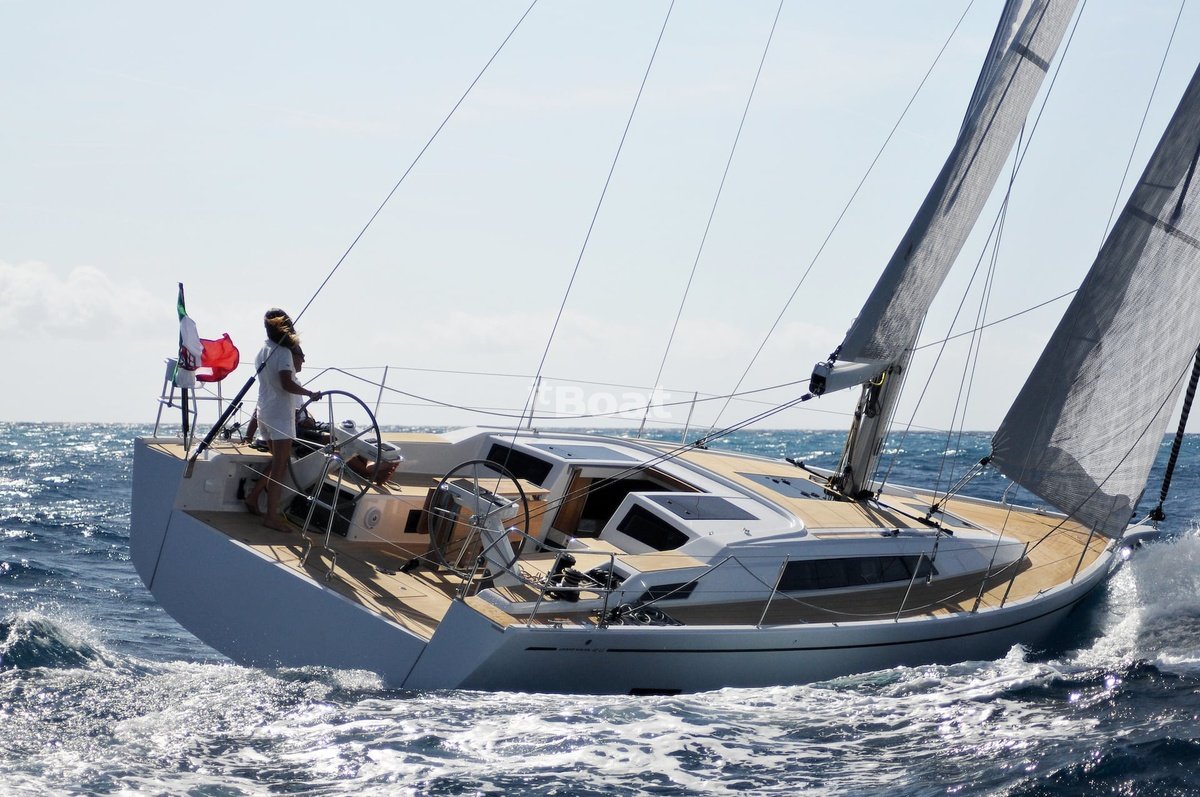


Grand Soleil 42 LC Specifications
Main Specs
| Length, m | 13.85 |
| Beam, m | 4.18 |
| Draft, m | 2.25 |
| Displacement, kg | 9600 |
Classification
| Hull Type | Fin w/bulb & spade rudder, Monohull |
| Type by Usage | Cruiser |
| CE Class | A - Ocean |
| Hull Material | Fiberglass / GRP, GRP |
| Design | Modern / Mainstream |
| Deck Arrangement | With mediterranean cockpit |
Rigging and Keel
| Rig | 9, Single-masted (sloop) |
| Keel | Fixed |
| Max Draft, m | 2.25 |
Cabins & Passenger Capacity
| Cabins | 2 |
| Berths for Guests | 4 |
| Bathrooms | 2 |
Engine
| Engine Type | Diesel |
| Engine Power | 50 |
Tanks Capacity
| Fuel capacity, l | 230 |
| Water tank, l | 340 |
Manufacturer Information
| Shipyard | Grand Soleil Grand Soleil (Cantiere del Pardo) |
| Country | Italy |
| Model | 42 LC |
| Designer | Lostuzzi Yacht Design |
| Period of manufacturing | 2019 - now |
Technical Specs
| LOA, m | 13.85 |
| Sail Area (S.A.), m² | 103.5 |
| Ballast, kg | 2735 |
Sailboat Calculations
S.A. / Displacement Formula
SA/D = SA (ft²) ÷ [Disp (lbs) / 64]^0.666
A sail area/displacement ratio below 16 would be considered under powered; 16 to 20 would indicate reasonably good performance; above 20 suggests relatively high performance.
SA/D = SA (ft²) ÷ [Disp (lbs) / 64]^0.666
A sail area/displacement ratio below 16 would be considered under powered; 16 to 20 would indicate reasonably good performance; above 20 suggests relatively high performance.
Ballast / Displacement Formula
Bal./Disp = ballast (lbs)/ displacement (lbs)*100
A Ballast/Displacement ratio of 40 or more translates into a stiffer, more powerful boat that will be better able to stand up to the wind.
Bal./Disp = ballast (lbs)/ displacement (lbs)*100
A Ballast/Displacement ratio of 40 or more translates into a stiffer, more powerful boat that will be better able to stand up to the wind.
Capsize Screening Formula
CSF = Beam ÷ (Disp in cubic ft)^(1/3)
Designed to determine if a boat has blue water capability. The CSF compares beam with displacement since excess beam contributes to capsize and heavy displacement reduces capsize vulnerability. The boat is better suited for ocean passages (vs coastal cruising) if the result of the calculation is 2.0 or less. The lower the better.
CSF = Beam ÷ (Disp in cubic ft)^(1/3)
Designed to determine if a boat has blue water capability. The CSF compares beam with displacement since excess beam contributes to capsize and heavy displacement reduces capsize vulnerability. The boat is better suited for ocean passages (vs coastal cruising) if the result of the calculation is 2.0 or less. The lower the better.
| S.A. / Displacement | 23.39 |
| Ballast / Displacement, % | 28.49 |
| Capsize Screening Formula | 1.99 |
Rig and Sail Particulars
S.A. Fore Formula
S.A. Fore = I * J / 2
This is the area of the fore triangle, calculated by multiplying I and J and dividing by 2.
S.A. Fore = I * J / 2
This is the area of the fore triangle, calculated by multiplying I and J and dividing by 2.
S.A. Main Formula
S.A. Main = P * E / 2
This is the area of the main triangle, calculated by multiplying P and E and dividing by 2.
S.A. Main = P * E / 2
This is the area of the main triangle, calculated by multiplying P and E and dividing by 2.
S.A. Total Formula
S.A. Total = S.A. Fore + S.A. Main
This is the sum of the fore and main sail areas.
S.A. Total = S.A. Fore + S.A. Main
This is the sum of the fore and main sail areas.
Forestay Length Formula
Est. Forestay Length = √(I² + J²)
This is the length of the forestay, calculated using the Pythagorean theorem.
Est. Forestay Length = √(I² + J²)
This is the length of the forestay, calculated using the Pythagorean theorem.
| I, m | 17.19 |
| J, m | 5 |
| P, m | 16 |
| E, m | 5.7 |
| S.A. Fore, ft²m² | 462.58 42.98 |
| S.A. Main, ft²m² | 490.83 45.6 |
| S.A. Total, ft²m² | 953.41 88.58 |
| Est. Forestay Length, ftm | 58.73 17.9 |