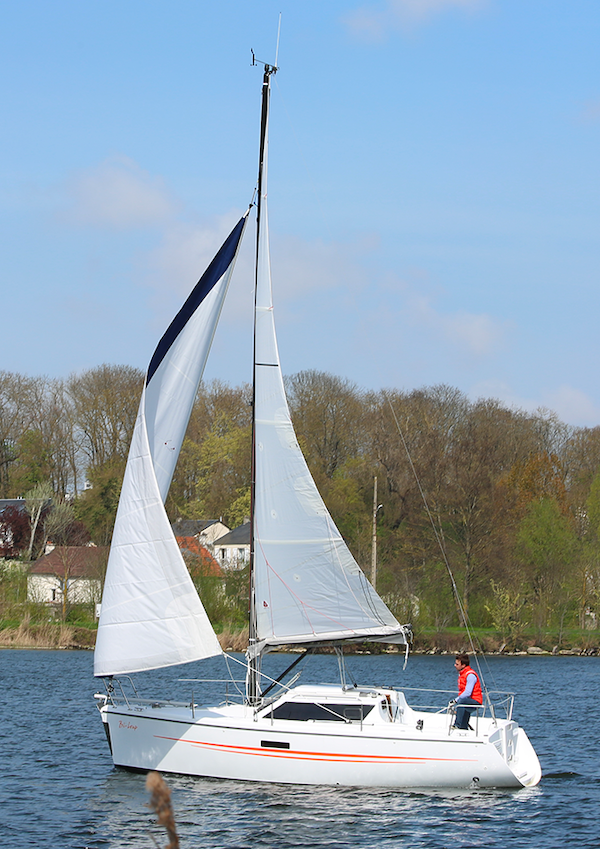


Wrighton 26 Specifications
Main Specs
| Length, m | 7.8 |
| Draft, m | 0.9 |
| Displacement, kg | 1800 |
Classification
| Hull Type | Twin Keel |
| Hull Material | FG |
Rigging and Keel
| Rig | Fractional Sloop |
| Max Draft, m | 0.9 |
Engine
| Engine Type | Diesel |
| Engine Model | Yanmar |
| Engine Power | 14 |
Tanks Capacity
| Fuel capacity, l | 40 |
| Water tank, l | 140 |
Manufacturer Information
| Shipyard | Wrighton Yachts (FRA) |
| Country | France |
| Period of manufacturing | 2018 - now |
Technical Specs
| LOA, m | 7.8 |
| LWL, m | 7.5 |
| Sail Area (S.A.), m² | 38 |
| Ballast, kg | 600 |
Sailboat Calculations
S.A. / Displacement Formula
SA/D = SA (ft²) ÷ [Disp (lbs) / 64]^0.666
A sail area/displacement ratio below 16 would be considered under powered; 16 to 20 would indicate reasonably good performance; above 20 suggests relatively high performance.
SA/D = SA (ft²) ÷ [Disp (lbs) / 64]^0.666
A sail area/displacement ratio below 16 would be considered under powered; 16 to 20 would indicate reasonably good performance; above 20 suggests relatively high performance.
Ballast / Displacement Formula
Bal./Disp = ballast (lbs)/ displacement (lbs)*100
A Ballast/Displacement ratio of 40 or more translates into a stiffer, more powerful boat that will be better able to stand up to the wind.
Bal./Disp = ballast (lbs)/ displacement (lbs)*100
A Ballast/Displacement ratio of 40 or more translates into a stiffer, more powerful boat that will be better able to stand up to the wind.
Displacement / Length (LWL) Formula
D/L = (Disp / 2240) / (0.01 × LWL)^3
The lower a boat’s Displacement/Length (LWL) ratio, the less power it takes to drive the boat to its nominal hull speed.
less than 100 = Ultralight; 100-200 = Light; 200-275 = Moderate; 275-350 = Heavy; 350+ = Ultraheavy;
D/L = (Disp / 2240) / (0.01 × LWL)^3
The lower a boat’s Displacement/Length (LWL) ratio, the less power it takes to drive the boat to its nominal hull speed.
less than 100 = Ultralight; 100-200 = Light; 200-275 = Moderate; 275-350 = Heavy; 350+ = Ultraheavy;
S# Formula
S# = 3.972 × 10^(–(D/L)/526 + (0.691 × (log(SA/D) – 1)^0.8))
S# first appeared (that we know of) in TellTales, April 1988, “On a Scale of One to Ten” by A.P. Brooks. The equation incorporates SA/Disp (100% fore triangle) and Disp/length ratios to create a guide to probable boat performance vs. other boats of comparable size. For boats of the same length, generally the higher the S#, the lower the PHRF.
Under 2 – Slow, under powered; 2-3 – Cruiser; 3-5 – Racer Cruiser; 5+ – Fast/Racing
S# = 3.972 × 10^(–(D/L)/526 + (0.691 × (log(SA/D) – 1)^0.8))
S# first appeared (that we know of) in TellTales, April 1988, “On a Scale of One to Ten” by A.P. Brooks. The equation incorporates SA/Disp (100% fore triangle) and Disp/length ratios to create a guide to probable boat performance vs. other boats of comparable size. For boats of the same length, generally the higher the S#, the lower the PHRF.
Under 2 – Slow, under powered; 2-3 – Cruiser; 3-5 – Racer Cruiser; 5+ – Fast/Racing
Hull Speed Max Formula
HS = 1.34 × √LWL (in feet)
The maximum speed of a displacement hull (referring to a hull that travels through the water rather than on top of it, e.g. planing).
HS = 1.34 × √LWL (in feet)
The maximum speed of a displacement hull (referring to a hull that travels through the water rather than on top of it, e.g. planing).
| S.A. / Displacement | 26.18 |
| Ballast / Displacement, % | 33.33 |
| Displacement / Length (LWL) | 118.91 |
| S# | 5.21 |
| Hull Speed Max, knots | 6.65 |